
When Nucleons Melt: The CMS Experiment’s Breakthrough
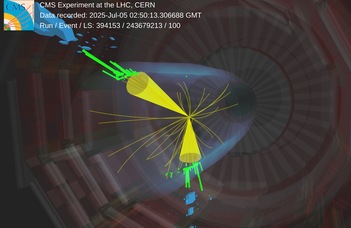
Physicists have long been investigating how lead nuclei, when smashed together at nearly the speed of light, can create an extremely hot and dense form of matter known as quark–gluon plasma (QGP) — a state thought to resemble the conditions of the universe immediately after the Big Bang. Now, by colliding lighter nuclei, the CMS research team — including physicists from ELTE and the Wigner Research Centre — has taken a significant step closer to understanding how QGP is formed, offering new insights into the earliest moments of our universe.

Figure 1: An image of an oxygen–oxygen collision recorded in the CMS detector. The yellow curves trace the paths of outgoing charged particles, the green bars show the deposited energy in the detector, and the yellow cones represent particle jets.
In Search of the Quark–Gluon Plasma
One of the key methods for studying the quark–gluon plasma (QGP) is the phenomenon known as jet quenching. In high-energy collisions, quarks and gluons form particle jets (Fig. 1). When these jets pass through the hot and dense QGP, they lose energy, which prevents the creation of additional particles. Researchers measure this effect using the so-called nuclear modification factor (RAA), which shows how the number of particles produced in heavy-ion collisions compares to those measured in proton–proton collisions. Since proton–proton collisions do not produce QGP, they serve as a reference.
Until now, clear evidence of jet quenching had only been observed in collisions of very heavy nuclei, such as lead and xenon. In smaller systems — for example, proton–lead collisions — the phenomenon was absent. This raised an important question for physicists: how large must an atomic nucleus be for QGP to form?
A Breakthrough with Light Nuclei
The CMS experiment has now provided an answer by colliding lighter nuclei — oxygen (¹⁶O) and neon (²⁰Ne). The first analysis of data collected at the LHC in July 2025 confirmed the presence of jet quenching in oxygen–oxygen collisions (the measured RAA values were significantly below 1, in some regions even dropping below 0.7; Fig. 2). This means that the hot, deconfined state of QGP can emerge even in a relatively small system. These results are in line with theoretical models that take energy loss into account.
As the next step, researchers also carried out initial measurements in neon–neon collisions. Since the neon nucleus (²⁰Ne) is slightly larger than the oxygen nucleus (¹⁶O), comparing these results with data from larger systems (¹²⁹Xe, ²⁰⁸Pb) will make it possible to study the system-size dependence of jet quenching in a model-independent way.


Figure 2: The nuclear modification factor (RAA) of charged particles in oxygen–oxygen collisions at 5.36 TeV, plotted as a function of the particles’ transverse momentum (pT). According to the CMS measurement (blue rectangles), the observed ratio is well below 1. The results were compared with theoretical models without energy loss (left panel) and with energy loss included (right panel). A good agreement was found only with the latter.
The Significance of the Discovery
The data from oxygen–oxygen and neon–neon collisions fill an important gap between small and large collision systems. While QGP-like phenomena had already been observed in proton–lead collisions, no signs of jet quenching had previously been detected. The CMS experiment has now, for the first time, successfully identified this phenomenon in collisions of light nuclei. Studying this hot, deconfined state of quark matter at CERN continues to push the boundaries of physics, offering new insights into the very earliest stages of the universe.
The work was carried out by a nearly twenty-member team led by researchers from the University of Chicago and the Massachusetts Institute of Technology (MIT). Scientists and students from the Institute of Physics at ELTE’s Faculty of Science and the HUN-REN Wigner Research Centre for Physics also played an important role in data collection, analysis, and interpretation.
The participation was supported by the NKFI Fund projects K 146913, K 146914, and K 143460, as well as by the Thematic Excellence Program (TKP2021-NKTA-64). The CMS Collaboration will present these results [1] at the international Initial Stages 2025 conference [2].
[1] CMS Physics Analysis Summary CMS-PAS-HIN-25-008
[2] https://indico.cern.ch/event/1479384/
(Source: ELTE TTK Physics Department, HUN-REN Wigner FK)