
Towards AI Regulation at ELTE
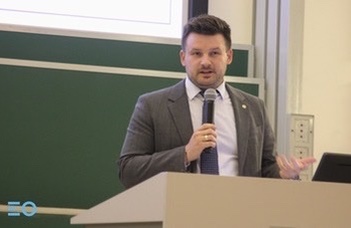
At the beginning of the event, Szabolcs Vedres, Vice President for Academic Affairs of the ELTE Student Union, welcomed the university community present, then gave the floor to Dr. Gábor Juhász. In his address, the Vice-Rector for Educational and Academic Affairs emphasized that the university leadership—aligned with the rector’s program—is committed to supporting the use of AI. The aim is for students to be able to use this disruptive technology in a way that ensures educational goals, such as the thorough and meaningful mastery of their respective disciplines, remain central.
Dr. Áron Badinszky, the Rector’s Commissioner responsible for coordinating the ELTE Artificial Intelligence Flagship Project, delivered a detailed presentation outlining the university leadership’s vision for student use of AI and the framework of the planned regulations. He highlighted that in developing these rules, significant emphasis was placed on involving all stakeholders, including faculty experts and the Student Union, as well as integrating existing university practices on AI regulation.
As a starting point, he stressed that ELTE does not intend to ban or strictly restrict a technology that already significantly shapes our present and will undoubtedly have an enormous impact on our future. Instead, the university aims to support the responsible and skill-based use of AI as widely as possible—a goal supported by market demands, since familiarity with AI provides students with a clear competitive advantage, at least within their fields of study.
The goal is to foster a culture of responsible and conscious AI use
in order to promote genuine, in-depth knowledge, the development of critical thinking, and alignment with labor market needs. The operational committee preparing the university-level AI regulations seeks to ensure that students can use AI for any purpose, while also understanding its use and, in certain cases, documenting it explicitly.

According to the plans, AI will be widely supported and may be used for assignments, theses, and term papers, though certain limitations will apply. It will definitely be considered prohibited use to present AI-generated content as one’s own work, to use AI during in-class tests or exams (unless the task specifically requires it), and to enter sensitive data into AI systems. The university also aims to introduce a compulsory AI-related course for all ELTE students, in order to ensure that everyone acquires basic AI literacy.
The university-level regulations will be supplemented by additional faculty-level rules, which will take into account the specific characteristics of each faculty and discipline.
Following the plenary lecture, participants were able to submit questions anonymously through a dedicated platform, which the Rector’s Commissioner answered in detail. Questions included topics such as opportunities for students with special needs, methods of AI detection, ethical aspects of the technology, AI use for teaching purposes, and details of the planned regulations.
Dr. Áron Badinszky stated that the rectoral directive regulating AI use is expected to come into force during October, and that the principle of graduality will apply to any legal consequences—discussions on this are still ongoing. The flexibility and continuous revision of the regulations will be ensured by placing them in a rectoral directive rather than in the Student Requirements System (HKR), which will allow them to remain up to date.
Photo: ELTE Online / Renáta Tóth