
“There are no better experts in the country in this field.”
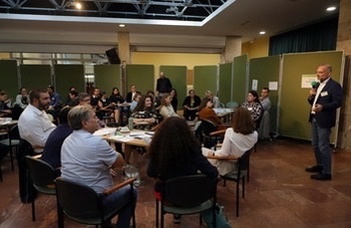
The first DOKK workshop, launched two years ago, aimed to ensure that DOKK would not be just a collection of projects, but a true creative community where quality, validated developments could emerge through knowledge exchange and collaboration. Since then, more than 160 educators and researchers have been working within DOKK on scientifically grounded, quality-assured solutions to improve education. The regularly organized workshops provide an excellent opportunity for participants to think together, share knowledge, and draw inspiration from different thematic focuses.
In his opening remarks, professional director Tamás Cseszregi emphasized:
“DOKK is not merely a consortium, but a university community,
which seeks to answer the question of how to teach digitally in a good and effective way. However, educational development cannot be achived without the faculties, the strongholds of education." The EduFLOW scholarship program is one of the most important pillars of this effort: it has created a cross-faculty team of experts that participates both in university-level strategy-making and in its practical implementation—from digital learning material development to the innovative renewal of training systems.

The special feature of the 9th workshop was that the university’s new rector, Lénárd Darázs, presented his program here following his inauguration in the summer. He identified the Student-Centered Digital Skills and Competence Development Center as a flagship initiative, placing it on the same level as the AI and Disruptive Technologies Knowledge Center and the University Center for Sustainable Development Goals.
Together, the three pillars can ensure the university’s competitiveness,
at the same time, each is also crucial on its own in laying the foundations for the future. The rector emphasized: "These projects are part of a comprihensive development concept, the aim of which is to ensure the university's sustainability and its ability to social realities."

In the first block of the event, participants were introduced to the main directions of the rector’s strategy, which aims to renew competitiveness and create a student-centered and inclusive institution. An institution where everyone can find their own path of development, where active international relations allow us to seek answers together to the challenges of the 21st century, while creating a working and learning environment that offers both professional fulfillment and a sense of community.
The presentation of the strategic directions was followed by a panel discussion with Helga Dorner, Bernadette Somody, Balázs Aczél, and Dániel Takács, moderated by Ildikó Chogyelkáné Babócsy. The discussion addressed key questions such as: How can we engage and win over instructors for the cause of competence development? How can we create methods that focus on individual attention and growth rather than solutions that reinforce differences? How should we respond to the continuously changing set of competences that incoming students bring with them? How can we align context creation and the integration of basic skills with competent tool use? In what ways do teaching and research roles intersect in mentoring? Why is it important to interpret competence development as attitude formation, and how does this go beyond mere knowledge of software use? Finally, how can we navigate the complex and constantly changing world of AI safely and ethically?

The discussion revealed that developing teaching competences goes far beyond acquiring digital skills. It also encompasses abilities such as advising, giving feedback, and mentoring, while placing special emphasis on attitudes and one’s relationship to technology. Resistance, therefore, is not a matter of age but of mindset. The participants emphasized:
Technology is not an end in itself, but a tool,
which can help in completing tasks and working more efficiently.
An important point raised was the need to connect basic digital skills—such as word processing or calendar use—with areas like data management and organizing publications. The ability to handle information and think critically is also essential; both students and instructors must learn how to structure knowledge and evaluate sources, especially in an age of AI-generated content that is often unverified. In other words, we must first learn to ‘walk’—that is, to think critically—before we ‘get in the car,’ meaning before we start using AI.

The role of artificial intelligence in education emerged as a central theme. AI is transforming the role of educators: teachers are increasingly acting as mentors and facilitators who, while not required to master every technical detail, must be able to make responsible decisions about integration and ethical use, taking into account the social and environmental implications of AI.
The discussion also highlighted that collaboration and multidisciplinary teamwork are essential for the safe and effective use of AI. Partnerships similar to the CEEPUS program can support educators in navigating challenges not in isolation but within a strong community framework. Finally, a key idea emerged:
the students must be taught how to learn again:
to ask good questions and give clear instructions, since these skills—much like prompt engineering—are essential for the effective and responsible use of AI.
After the panel discussion, participants continued working in groups, exploring the main areas of teaching competence development: the use of digital pedagogical tools and methodologies, the role of teaching skills and soft skills, the integration of learning assessment and student feedback, as well as the competence requirements that arise at different stages of an academic career.
The results of their collaborative work showed that the project leaders, vice-deans for education, and EduFLOW scholarship holders brought not only their experience but also tangible solutions and fresh perspectives. The shared practices and ideas confirmed the words of Lénárd Darázs: "There are no better experts in the country in this field."
More photos: elte.hu