
Do you need a flashlight for financial due diligence?
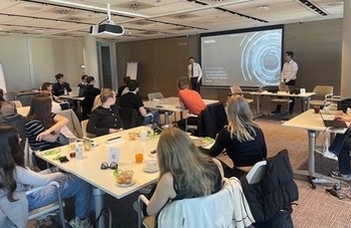
On the first day, the focus was on financial due dilligence and financial advisory. Students gained insight into the operations of Deloitte’s Financial Advisory M&A team, learning about the work of financial consultants and the key aspects to consider in mergers and acquisitions. They discovered the perspective companies use when examining and evaluating potential acquisition targets. For many participants, this was a completely new topic, yet they found these unique intercompany transactions highly interesting and felt that they would gladly work in such a field. The lectures provided them with a comprehensive understanding of how financial due diligence works, and they also had the chance to apply their newly acquired knowledge through practical examples.
The second day of the course focused on auditing and financial fraud. First, participants became familiar with the organizational structure of the firm, learning who is responsible for which areas, and were introduced to the auditing process along with the programs used in practice. What particularly captured the students’ attention was the way an auditor can extract insights from the data, helping them understand why thorough knowledge of accounting is so essential. Next, the presenters addressed the concept of fraud, explaining the motivations that may lead to it and the warning signs that auditors look for. After the theory-based morning session, enriched with illustrative examples, the afternoon was devoted to a team task, where students had to apply what they had learned. The value of teamwork was further enhanced by the fact that, at the end of the day, the teams shared their solutions with one another, learning from each other’s approaches as well.

Students found the lectures engaging, well-paced, and interactive, enriched in every case with concrete examples provided by the firm’s professionals. It proved ideal that the case study followed directly after the “insightful” presentation rather than being placed at the very end of the training. The group work turned out to be a particularly exciting task, during which participants could ask for help whenever they felt it necessary. Several students highlighted that, in addition to the presenters’ outstanding professional expertise, their approachability, enthusiastic delivery, and the positive atmosphere encouraged them to ask questions with confidence. Beyond the professional presentations, the organizers also proved to be very thoughtful hosts, providing participants with food and refreshments.
Based on the training, participants concluded that they need to further expand their expertise in finance and accounting. They also realized, in light of the digital solutions presented, that they should improve their knowledge, use, and application of Power BI and other business software. Furthermore, they recognized the essential role of professional English in everyday work. Overall, they believe that the knowledge acquired at university should be applied more effectively to specific issues. At the same time, the business simulation at Deloitte significantly contributed to enhancing their analytical and logical thinking, as well as their problem-recognition skills, during the practical tasks.

To conclude, let us share the reflections of our undergraduate student, Levente Márk Marek, on the two-day intensive training: “I really enjoyed the course, especially its practical approach. It was truly inspiring that Deloitte professionals presented the process of financial due diligence and data-driven auditing procedures through real-life examples. This practical perspective made the theoretical knowledge much more tangible and gave me a glimpse into how these processes unfold in real life. For me, the most interesting part of the course was learning about the meaning and steps of financial due diligence, and I feel that, as a result, I would gladly deepen my expertise in this area at a professional level in the future. However, I not only enjoyed the practical tasks, but also found the lectures themselves highly engaging. I particularly appreciated that the professionals shared not only successful, but also problematic cases, which helped me gain a more nuanced picture of the challenges involved. Through these examples, I better understood the role of data in fraud detection, and how much a data-driven approach is shaping the future of auditing. The course also highlighted how essential critical thinking and analytical skills are in these processes.”
Photos: Deloitte